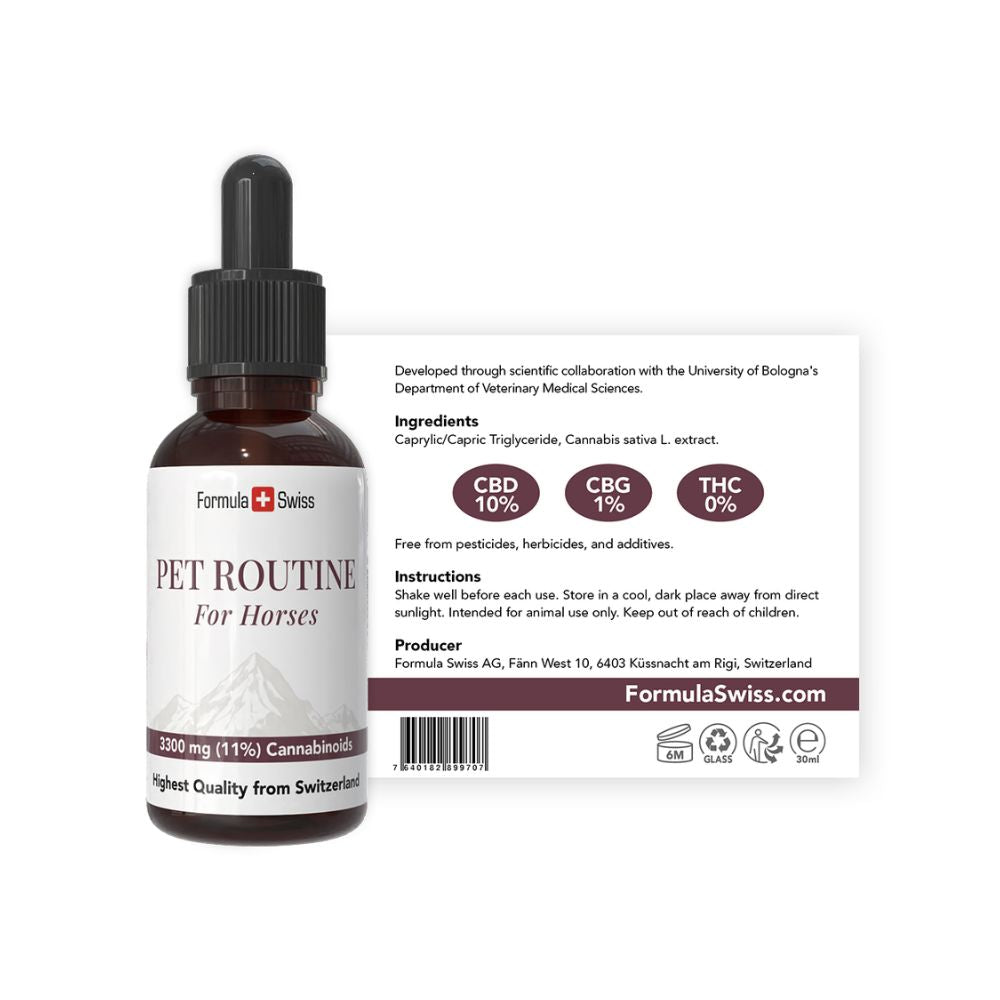

























Pet Routine for Horses
10% CBD Oil · 30 ml · 2026 formula
Made in Switzerland using hemp grown following organic principles and an MCT carrier oil. A vegan formula with 0% THC, backed by more than 10 years of Formula Swiss CBD experience.
Pet Routine for Horses
- Made in Switzerland since 2013
- Hemp grown following organic principles
- Vegan
- 2026 formula
- 0% THC
Couldn't load pickup availability
Free shipping over £49
Buy more, save more
Description
Description
Pet Routine for Horses is a CBD oil for external use on animals. The 30 ml bottle contains 3,300 mg cannabinoids: 10% CBD and 1% CBG in MCT oil, with 0% THC. The oil is vegan.
Shake the bottle and apply the drops directly to the horse's skin as directed on the label. The product is for external use only and must not be given by mouth or added to food. Ask your vet if your animal takes medicines.
Made in Switzerland from hemp grown following organic principles and extracted with CO₂. Every production batch is tested. The batch number is printed on the label: send it to us and we will find the certificate of analysis for your batch, or see our published certificates under Test results.
Ingredients & formula
Ingredients & formula
| Cannabinoid | Concentration | Per bottle |
|---|---|---|
| CBD | 10% | 3,000 mg |
| CBG | 1% | 300 mg |
| Total cannabinoids | 11% | 3,300 mg |
Labelled formula values, not individual laboratory measurements. Carrier: MCT oil (Caprylic/Capric Triglyceride). THC specification: 0%. See Testing & certifications for the laboratory report.
How to use & important information
How to use & important information
Apply the drops to your horse’s skin as described on the label. Ask your vet if you are unsure.
Pet Routine for Horses is not a registered veterinary medicine.
Storage & shelf life
Storage & shelf life
Storage
Shelf life
Testing & certifications
Testing & certifications
Registrations & certifications
What customers say about Formula Swiss
See all Formula Swiss reviews (opens in a new window)These are reviews of Formula Swiss and its CBD oils generally, not verified experiences with Pet Routine for Horses. Each links to the original Trustpilot review.
-
Read original review (opens in a new window)Superb products! My favourite shop to order CBD oil of the highest quality!
-
Read original review (opens in a new window)It is satisfying to be able to give my highest recommendations.
CBD for horses: our university research and other published studies
The university tissue studies explain where cannabinoids may act in horses. Other researchers tested different preparations, with positive, mixed and no-benefit findings. None of these publications tested Pet Routine for Horses, which is for external use only.
Our university research partnership
Our horse research at the University of Bologna
Formula Swiss has funded research by Professor Roberto Chiocchetti's team at the University of Bologna into how cannabinoids could act in horses. The university's record lists a 2019–2021 Formula Swiss-funded project on CBD receptors in the horse's gut and spinal nerve ganglia, and three of the studies below name Formula Swiss as their funder. These are laboratory studies of horse tissue. They show where cannabinoids may act in the body, but they did not test a CBD product in living horses or establish a dose.
Read the university project record (opens in a new window)-
Tissue study
Cannabinoid receptors in horses' sensory nerve cells (opens in a new window)
- What they did
- Researchers examined sensory nerve cells from the necks of six horses.
- What happened
- Cannabinoid and related receptors were mapped in cells that carry touch and pain signals.
- Good to know
- Laboratory study of tissue from six horses. It shows where cannabinoids may act, not whether CBD relieves pain.
Tissue study · 2020
-
Tissue study
Cannabinoid receptors in the horse's small intestine (opens in a new window)
- What they did
- Researchers examined the final part of the small intestine from six healthy horses.
- What happened
- Cannabinoid-related receptors were found in the intestinal lining, immune cells, nerves and muscle.
- Good to know
- Tissue from six healthy horses. It provides a basis for research on gut conditions such as colic, but no treatment was tested.
Tissue study · 2021
-
Tissue study
CBD-related receptors in horses' sensory nerve cells (opens in a new window)
- What they did
- Researchers examined CBD-related receptors in nerve tissue from six horses.
- What happened
- Four CBD-related receptors were found in many sensory nerve cells and their supporting cells.
- Good to know
- Laboratory study of tissue from six horses; first published online in 2021, journal issue 2022. No CBD product was tested.
Tissue study · 2021
-
Tissue study
Cannabinoid receptors in the main sensory nerve of the horse's face (opens in a new window)
- What they did
- Researchers examined facial sensory nerve ganglia from five horses.
- What happened
- Cannabinoid-related receptors were found in most nerve cells in the facial sensory ganglion.
- Good to know
- Laboratory tissue study. It supports further research into facial nerve disorders, but no treatment was tested.
Tissue study · 2023
What other CBD and cannabinoid studies in horses found
Published equine research, grouped by topic. Small trials and different preparations limit what we can conclude. A placebo is a dummy oil or paste without the active cannabinoids, used for comparison.
Joint pain and pain sensitivity
5 studies
-
Tissue study
Cannabinoid receptors in inflamed horse joints (opens in a new window)
- What they did
- Researchers examined stored tissue from 25 fetlock joints with different levels of inflammation.
- What happened
- Both main cannabinoid receptors were present and increased with more severe joint inflammation.
- Good to know
- Tissue-bank study from the University of Montreal. It identifies possible treatment targets, but no treatment was tested.
Tissue study · 2022
-
Tissue study
Cannabinoid receptors in the lining of horse fetlock joints (opens in a new window)
- What they did
- Researchers examined the lining of 14 fetlock joints collected after slaughter.
- What happened
- Cannabinoid-related receptors were found in joint lining cells and blood vessels.
- Good to know
- Laboratory study by the University of Bologna team, funded by NBF Lanes. No treatment was tested.
Tissue study · 2023
-
Positive result
CBD added to pain treatment for horses with osteoarthritis (opens in a new window)
- What they did
- Horses with mild osteoarthritis received usual pain treatment, with or without added CBD for 14 days.
- What happened
- Chronic pain scores fell in both groups, with lower scores in the CBD group.
- Good to know
- A small, short study in which both groups also received phenylbutazone. It does not show the effect of CBD on its own. The paper reports 20 horses in its abstract but 24 in its methods and tables.
Randomised controlled study · 2024
-
Early finding
CBDA, or CBG with CBD, for horses with chronic osteoarthritis (opens in a new window)
- What they did
- Twenty-four horses with osteoarthritis received CBDA or a CBG/CBD oil for 14 days, without an untreated group.
- What happened
- Pain scores fell in both groups; no adverse effects were reported.
- Good to know
- There was no untreated comparison group, and both oils differed from CBD alone. The improvements cannot be attributed to CBD or to Formula Swiss products.
Comparative study without an untreated group · 2024
-
Partly positive
Oral CBD and pain sensitivity in healthy horses (opens in a new window)
- What they did
- Six healthy horses received CBD or a dummy oil for three days in a crossover trial.
- What happened
- CBD raised the heat-sensitivity threshold at some time points but did not change sensitivity to pressure.
- Good to know
- Six healthy horses and an experimental test, so it does not show relief of pain from disease. Heart rate and temperature did not change.
Randomised masked crossover study · 2025
Stress and behaviour
4 studies
-
Early finding
CBD for crib-biting in one horse (opens in a new window)
- What they did
- A case report followed one 22-year-old mare with crib-biting during four weeks of CBD.
- What happened
- The mare’s crib-biting and wind-sucking improved during the observation period.
- Good to know
- A single horse without a comparison group. A case report cannot show that CBD caused the change.
Case report · 2023
-
No clear benefit
Single doses of CBD paste and horse behaviour (opens in a new window)
- What they did
- Researchers compared CBD paste with a dummy paste at three increasing single doses.
- What happened
- Sedation, facial expressions, heart rate and heart rate variability did not differ between the groups.
- Good to know
- Three to six healthy horses per group, and no side effects were seen. This is part 1 of a linked research programme.
Blinded controlled dose-escalation study · 2023
-
No clear benefit
Twice-daily CBD paste, horse behaviour and cortisol (opens in a new window)
- What they did
- Twelve horses received CBD or dummy paste twice daily for 15 days.
- What happened
- Behaviour, heart rate, cortisol and reactions to a new object and trailer loading did not differ between the groups.
- Good to know
- Twelve healthy horses. Linked to the single-dose study from the same programme, rather than an independent repeat.
Randomised double-blind controlled study · 2024
-
Tissue study
Cannabinoid receptors in a brain area linked to fear and stress (opens in a new window)
- What they did
- Researchers examined the lateral amygdala, a brain area linked to fear and stress, in six horses.
- What happened
- Cannabinoid receptors were found in this brain region.
- Good to know
- Laboratory study by the University of Bologna team, funded by NBF Lanes. It did not test whether CBD affects behaviour.
Tissue study · 2025
Skin and hooves
4 studies
-
No clear benefit
CBD in manuka honey on leg wounds in horses (opens in a new window)
- What they did
- Leg wounds in six horses were treated with CBD in manuka honey, honey alone or saline.
- What happened
- Healing did not differ between the treatments.
- Good to know
- Six horses with experimentally created wounds, and the CBD was in a honey carrier rather than an oil. The authors call for further research.
Preliminary experimental study · 2020
-
Tissue study
Cannabinoid receptors in healthy horse skin (opens in a new window)
- What they did
- Researchers examined skin samples and cultured skin cells from 15 healthy horses.
- What happened
- Both main cannabinoid receptors were consistently present in skin and skin cells.
- Good to know
- Describes normal skin only. It does not show that CBD applied to the skin has an effect.
Tissue and cell study · 2022
-
Tissue study
Cannabinoid receptors in healthy and laminitic hooves (opens in a new window)
- What they did
- Researchers compared tissue from 12 laminitic and six healthy hooves.
- What happened
- Receptor levels were higher in laminitic than healthy hoof tissue.
- Good to know
- Laboratory study by the University of Bologna team; the paper reports no funding. It suggests a research target, but no laminitis treatment was tested.
Tissue study · 2025
-
Tissue study
Cannabinoid receptors in immune and connective tissue cells of the hoof (opens in a new window)
- What they did
- Researchers examined immune and connective tissue cells in 18 healthy or laminitic hoof samples.
- What happened
- Receptors were located in immune cells, connective tissue, blood vessels and nerve fibres.
- Good to know
- Laboratory study of 18 hoof samples by the University of Bologna team, funded by NBF Lanes. No treatment was tested.
Tissue study · 2025
Immune function, metabolism and eyes
4 studies
-
Partly positive
Daily CBD for 90 days in senior horses (opens in a new window)
- What they did
- Twenty-seven senior horses received CBD or soya oil daily for 90 days.
- What happened
- CBD lowered some inflammation markers in the blood but did not change the response to vaccination or other health measures.
- Good to know
- Twenty-seven horses. Changes in blood markers do not show a clinical benefit.
Controlled study · 2023
-
No clear benefit
CBD and metabolism in Connemara ponies (opens in a new window)
- What they did
- Thirteen Connemara ponies received CBD or flaxseed oil twice daily for 21 days.
- What happened
- CBD did not improve body condition or blood sugar, and insulin responses rose in the CBD group.
- Good to know
- A small study. The authors say the insulin finding may raise concerns for ponies and horses prone to metabolic syndrome.
Randomised controlled study · 2026
-
Early finding
CBD oil and eye pressure in healthy horses (opens in a new window)
- What they did
- Researchers measured eye pressure after a single CBD dose in eight healthy horses.
- What happened
- Eye pressure fell for eight hours compared with the previous day, without a placebo comparison.
- Good to know
- Readings were compared with the same horses the day before, without a placebo. A later controlled study found no clinically relevant change.
Before-and-after study without a placebo group · 2025
-
No clear benefit
Daily CBD, eye pressure and tear production in horses (opens in a new window)
- What they did
- Six healthy horses received CBD or a dummy oil for three days in a masked crossover trial.
- What happened
- Eye pressure and tear production showed no clinically relevant differences.
- Good to know
- Six horses and three days of treatment. The results differ from an earlier study without a placebo group.
Randomised masked crossover study · 2026
Absorption and tolerability
13 studies
-
Safety study
Low single doses of CBD in exercising Thoroughbreds (opens in a new window)
- What they did
- Exercising Thoroughbreds received three low single doses of CBD in a crossover study.
- What happened
- CBD was well tolerated, with no behavioural, digestive or heart problems, and was still measurable in the blood after 72 hours.
- Good to know
- A small study with mixed effects on inflammation markers. The authors say more research is needed before CBD can be recommended as an anti-inflammatory.
Randomised crossover study · 2021
-
Safety study
Seven daily doses of a CBD supplement for horses (opens in a new window)
- What they did
- Seven horses received a CBD supplement at two daily amounts for seven days.
- What happened
- Both were well tolerated, and low levels of THC were also measured in the blood.
- Good to know
- Seven horses and one product that also delivered THC. It did not assess clinical effects.
Randomised crossover study · 2021
-
Safety study
Six weeks of oral CBD: absorption, joint fluid and safety (opens in a new window)
- What they did
- Twelve horses received CBD twice daily for six weeks, with blood and joint-fluid monitoring.
- What happened
- All horses had mildly low calcium and eight had raised liver enzymes, which improved or returned to normal within 10 days of stopping.
- Good to know
- Twelve horses and one oil-based product. Absorption varied widely, and effective doses were not established.
Randomised controlled study · 2022
-
Safety study
Daily CBD pellets for 56 days in Thoroughbreds (opens in a new window)
- What they did
- Twenty horses received pellets with or without 150 mg CBD daily for 56 days.
- What happened
- There was no sedation or unsteadiness, and blood tests did not change.
- Good to know
- Healthy horses and one fixed daily amount. The study assessed safety, not benefits.
Randomised masked controlled study · 2022
-
Safety study
How much CBD senior horses absorb (opens in a new window)
- What they did
- Eight senior horses received single CBD doses in a randomised crossover study.
- What happened
- About 8% of the oral dose reached the bloodstream, and no adverse effects were seen.
- Good to know
- Single doses in eight horses. Low absorption does not establish an effective dose.
Randomised crossover study · 2022
-
Safety study
CBD in oil or water-soluble form: absorption in horses (opens in a new window)
- What they did
- Eight horses received CBD in oil and water-soluble preparations, with blood-level monitoring.
- What happened
- About 14% of the oral dose was absorbed with either form, and no adverse reactions were seen.
- Good to know
- Eight horses per trial. The suggested treatment schedules were computer simulations, not tested effects.
Randomised crossover study · 2023
-
Safety study
CBD oil added to feed for mature horses (opens in a new window)
- What they did
- Thirty geldings received CBD oil or plain rapeseed oil on their feed for 28 days.
- What happened
- The oil was readily eaten, blood chemistry was unaffected and no banned substances were found in the blood.
- Good to know
- Testing showed the product contained far less CBD than its manufacturer's initial analysis indicated, so the horses received much less CBD than planned.
Randomised controlled study · 2023
-
Safety study
Single doses of CBD- and CBDA-rich hemp oil in horses (opens in a new window)
- What they did
- Eight horses received single doses of CBD/CBDA-rich hemp oil or no treatment.
- What happened
- There were no effects on behaviour, gait, digestion or blood chemistry.
- Good to know
- Single doses only. CBDA reached much higher blood levels than CBD, and the product also contained other cannabinoids.
Randomised crossover study · 2024
-
Safety study
Six weeks of CBD or CBDA oil: safety and absorption (opens in a new window)
- What they did
- Seven horses received CBD-rich and CBDA-rich oils for six weeks each, with blood tests and liver biopsies.
- What happened
- Blood tests and liver biopsies showed no clinically relevant changes, and CBDA reached higher blood levels than CBD.
- Good to know
- Seven healthy horses and full-spectrum extracts. The study assessed safety and absorption, not benefits.
Randomised crossover study · 2025
-
Safety study
CBD oil or paste, with or without a meal (opens in a new window)
- What they did
- Eight horses received CBD oil or paste after feeding or fasting.
- What happened
- Absorption did not differ significantly, although the paste reached its peak level sooner.
- Good to know
- Single doses in eight horses. The study measured absorption only.
Crossover study · 2025
-
Safety study
One dose of CBD oil in Connemara ponies (opens in a new window)
- What they did
- Ten Connemara ponies received a single CBD dose, followed by blood and urine sampling.
- What happened
- CBD was no longer detectable after 12 days, while a breakdown product remained measurable for 16 days.
- Good to know
- No comparison group. Heart rate was lower and some blood values changed after 24 hours.
Single-dose absorption study · 2025
-
Safety study
CBD compared with CBDA in horses (opens in a new window)
- What they did
- One pilot horse and seven trial horses received CBD, CBDA or placebo in an absorption study.
- What happened
- CBDA reached blood levels up to 67 times higher than CBD, and CBD was detectable in urine for up to seven days.
- Good to know
- One pilot horse and seven in the main study; it measured absorption, not effects. First published online in September 2025, journal issue 2026.
Randomised blinded crossover study · 2025
-
Safety study
How horses absorb and process CBG (opens in a new window)
- What they did
- Eight horses received CBG in different preparations while researchers measured absorption.
- What happened
- About 28% of the oral dose was absorbed, and no adverse effects were seen.
- Good to know
- The first study of CBG in horses. It measured absorption and breakdown, not effects.
Crossover study · 2025
Competition and drug testing
3 studies
-
Detection study
How long CBD stays in horses: data for doping control (opens in a new window)
- What they did
- Researchers measured CBD in blood and urine after single doses and 15 days of repeated use.
- What happened
- After repeated use, CBD left the body slowly, with a half-life of about 161 hours in serum.
- Good to know
- Designed to help testing laboratories interpret results. It does not set official detection times.
Single and repeated-dose study · 2023
-
Detection study
Hemp straw bedding, CBD oil and urine tests (opens in a new window)
- What they did
- Researchers studied cannabinoid detection after hemp-straw bedding exposure and CBD oil use.
- What happened
- The researchers advise against hemp straw bedding before competition unless at least 48 hours pass, and suggest that bedding exposure may be distinguishable from CBD oil use.
- Good to know
- Detection depends on the laboratory method and on each organisation's rules.
Experimental study · 2024
-
Detection study
Contaminated feed and CBD detection in horses (opens in a new window)
- What they did
- Twelve horses ate feed containing small amounts of CBD or CBDA for three days.
- What happened
- Both were detectable in the urine of all horses, but not after more than four days.
- Good to know
- Not designed to set detection times, and routine doping laboratories may be more or less sensitive.
Experimental study · 2026